New Center
What manufacturing challenges lurk behind compact motorcycle components?
If you have ever browsed a custom parts trade show or an aftermarket catalog, you have probably had this thought: "It is just a tiny piece of aluminum—why does it cost that much?" A brake lever, a footpeg bracket, a small triple clamp spacer… these parts fit in your palm, yet their price tags can rival an entire exhaust system. The truth is, small forged motorcycle parts are among the most demanding products in the entire manufacturing chain. Today, we will break down exactly why size has very little to do with difficulty—and why custom forged motorcycle parts command the prices they do.
1. Small Parts, Extreme LoadsMany motorcycle components are physically small but structurally critical. Take forged footpegs motorcycle as an example. These compact platforms support the rider's full weight, absorb lateral loads during aggressive cornering, and must survive impact during a crash. Any internal void, coarse grain boundary, or micro-crack can lead to sudden failure. That is why premium brands specify forged aluminum motorcycle parts over cast alternatives. During the forging process, metal undergoes plastic deformation under extreme pressure. The internal grain structure realigns along the direction of force, delivering density and fatigue strength that casting simply cannot match. 2. Forging Small Geometries Is a Mold-Making NightmareMany assume forging is just "squashing metal into a shape." In reality, producing 6061 T6 forged motorcycle parts and 7075 T6 forged aluminum parts involves tight process windows at every stage:
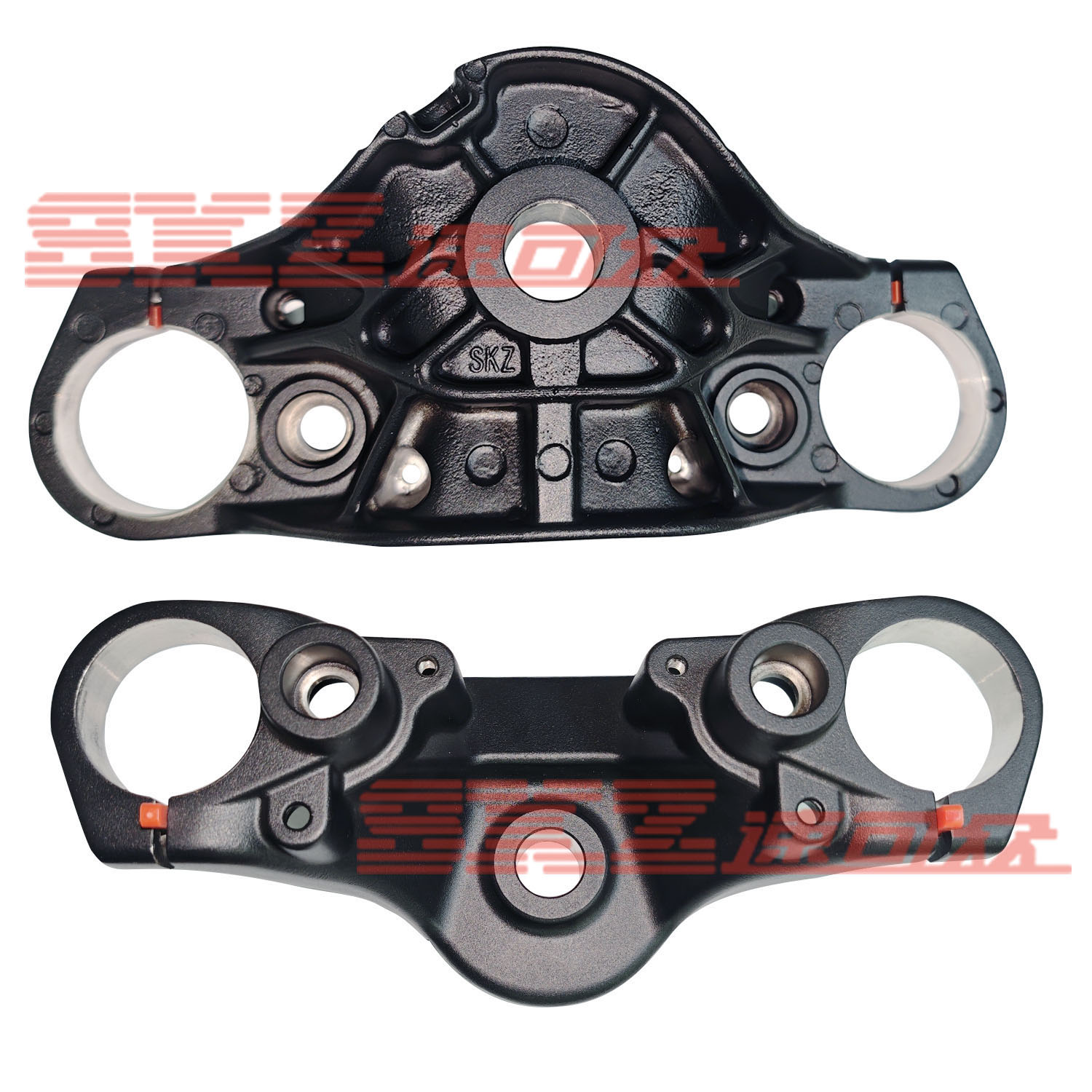
After forging, CNC machining after forging motorcycle becomes the next bottleneck. Forging pre-forms typically leave only 0.5–1.5 mm of stock. The CNC toolpath has almost zero margin for error. Small parts run at high spindle speeds, which means one miscalculation scraps the part in seconds—not minutes. 3. Why Not Just CNC the Whole Thing from a Block?A common question: "If you are CNC machining it anyway, why not just mill it from solid billet?" The answer lies in the fundamental difference of forged vs cast motorcycle parts—and billet, for that matter. Machining is a subtractive process; it cuts through the material's natural grain flow and leaves residual surface stress. Forging is formative; the grain remains continuous, which boosts fatigue strength by 20%–40%. For high performance forged motorcycle parts, that margin is the difference between a component that lasts a season and one that fails on lap five. That is exactly why forged brake caliper bodies and a forged shift lever on professional race bikes are almost always produced via "forge + precision CNC finish" rather than being cut from a solid block. 4. Surface Treatment: The Unforgiving Final ExamSmall parts have a high surface-area-to-volume ratio, which makes finishing brutally unforgiving. Consider black anodized forged triple clamps. The Type II anodized layer must sit between 15–25 μm. Too thin and it wears through quickly; too thick and it throws off assembly tolerances. Furthermore, forged aluminum's dense, uniform grain structure makes it an excellent substrate for anodizing—but it also means any micro-defect from forging (a die pick-up, a scale mark) becomes glaringly visible after coloring. This is a major reason why custom forged motorcycle parts often have lower yield rates than large forgings. Small components simply do not hide flaws.
5. B2B Reality: Why Small Parts Have Higher MOQsFrom a supply-chain perspective, a forged motorcycle parts manufacturer faces disproportionate tooling costs on small components. A footpeg forging die may require 4–6 parting directions. The die steel cost and CNC machining time for that die barely scale with part size. This is why low MOQ forged motorcycle parts suppliers usually rely on shared universal tooling or simplified processes—the latter often meaning compromised mechanical properties. A serious motorcycle forged parts OEM ODM supplier will typically quote higher minimum order quantities for small parts than for large ones, purely because the die amortization cost per unit is higher. SummaryThe manufacturing difficulty of a motorcycle component is not proportional to its size. It is proportional to its precision-to-density ratio: small volume means tight tolerance windows, critical function means zero tolerance for defects, and a long process chain means every single step must be executed flawlessly. Next time you pick up a small forged lever or bracket and wonder why it costs what it does, remember—you are not paying for a piece of aluminum. You are paying for metallurgy, die engineering, heat treatment science, and micron-level CNC precision, all stacked into something that fits in your hand.
|
||||||||||
| Return List |